 ENZAX
ENZAXSeven systems, built and documented.
All seven are self-initiated builds, designed and built in-house rather than commissioned. The breakdowns below show the actual problem, approach and solution behind each one.
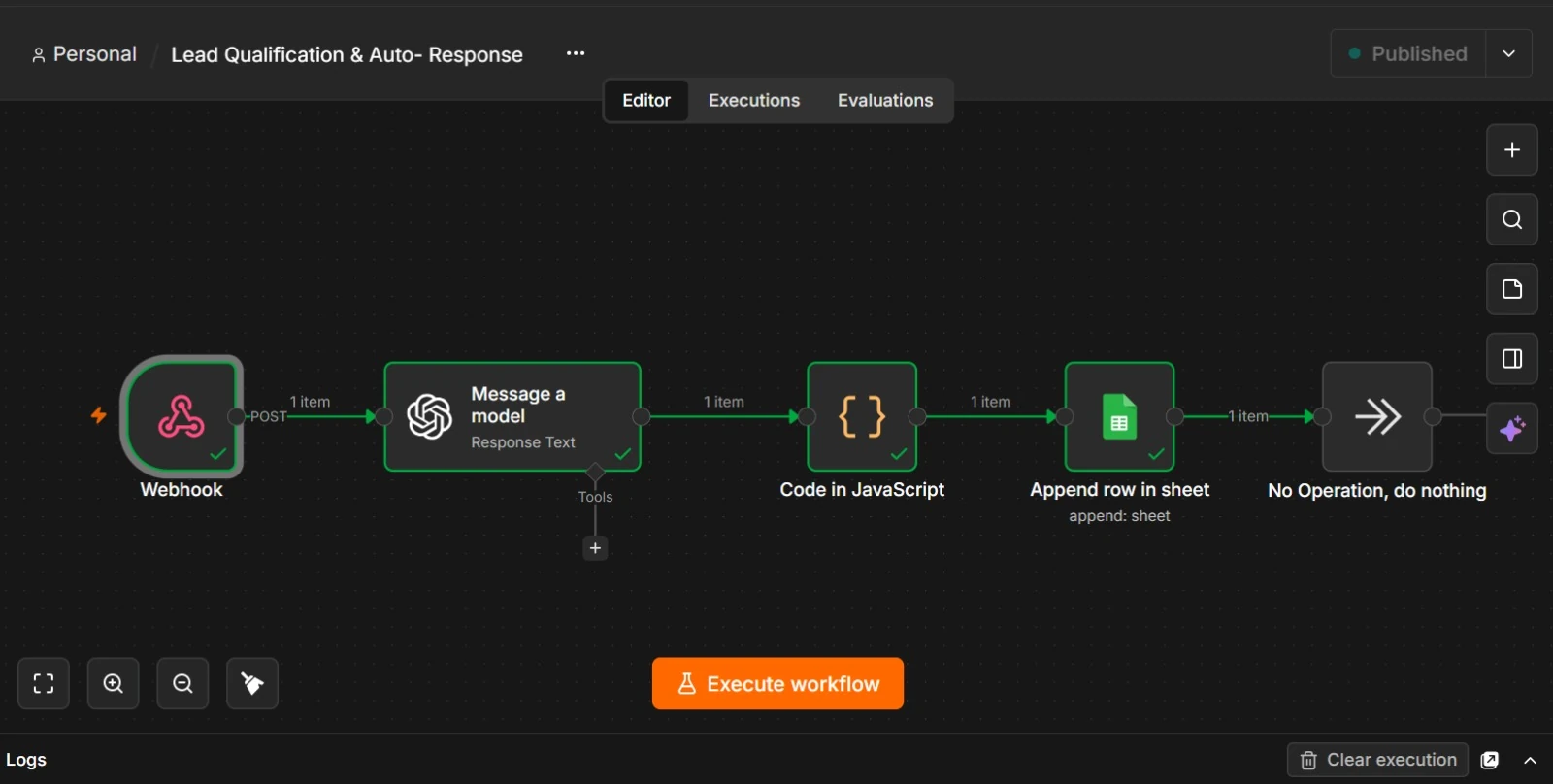
AI Lead Qualification & Auto-Response System
Self-initiated build — designed, built and tested in-house; not commissioned by a client.
- Problem
- Service businesses like small clinics lose time, and sometimes leads, when every inquiry has to be read, judged and answered by hand. Urgent messages end up sitting in the same queue as spam, and replies go out whenever someone finds a spare minute rather than when the lead actually needs one.
- Approach
- Instead of just routing messages, the system reads each inquiry, decides whether it's a real lead, and prepares a response, so a human only has to review and send instead of drafting from scratch.
- Solution
- Built in n8n — a webhook captures the incoming inquiry, GPT-5-mini analyzes the message to determine if it's qualified, how urgent it is, and what service is being asked for, then drafts a personalized reply. Everything is parsed and logged to a spreadsheet automatically.
WHAT IT DEMONSTRATES
- Real-time AI analysis of unstructured text
- Structured data extraction (JSON) from a language model
- End-to-end automation from trigger to logged record
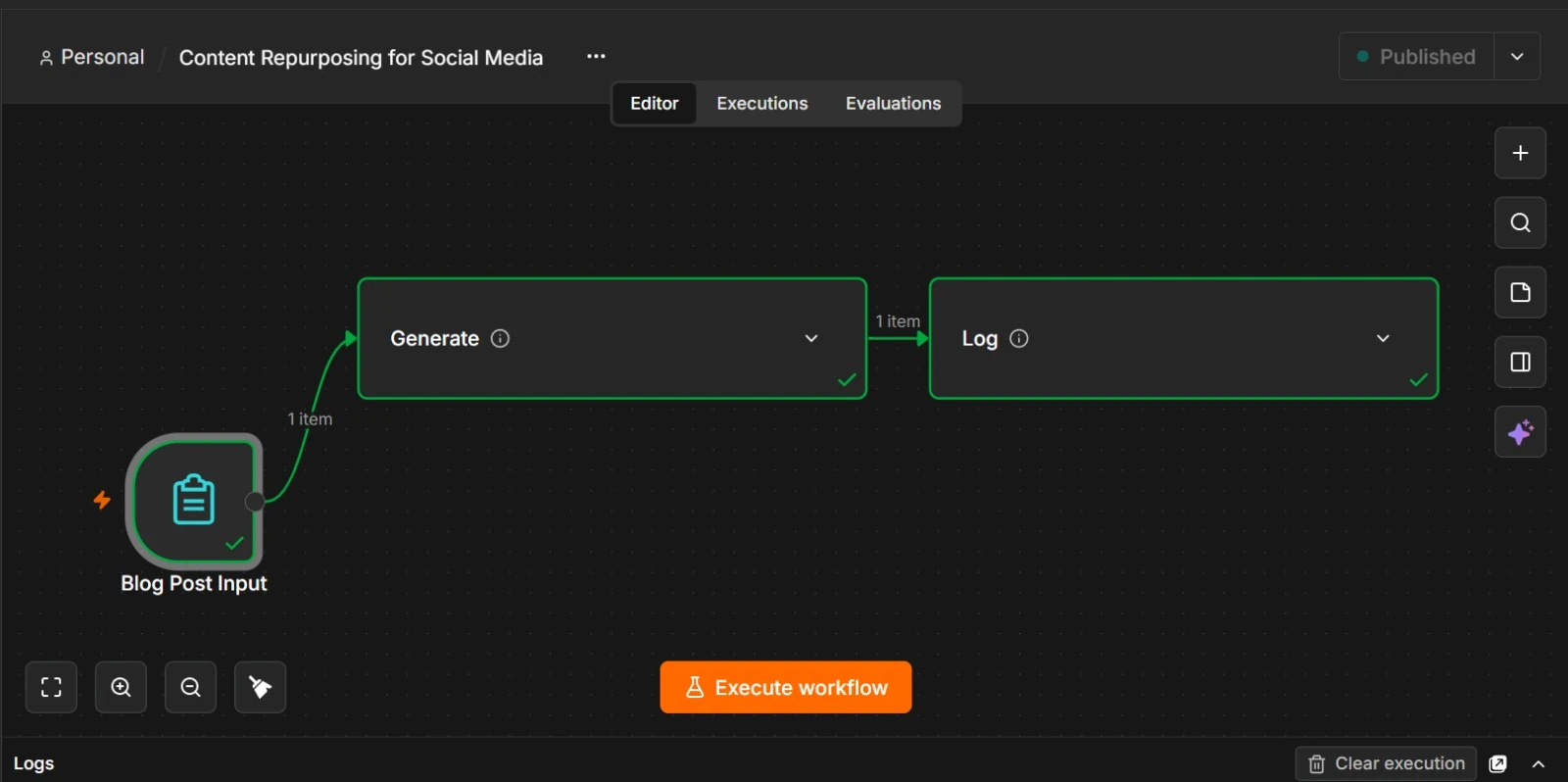
AI Content Repurposing System
Self-initiated build — designed, built and tested in-house; not commissioned by a client.
- Problem
- Writing one good blog post is only half the work — turning it into platform-ready social content (LinkedIn, Twitter/X, a newsletter summary) usually means starting from scratch each time, which most small teams don't have time for.
- Approach
- Take one piece of long-form content, let AI pull out its core message, and reshape it for each platform's tone and format. That replaces manually rewriting the same idea three times for three different feeds.
- Solution
- Built in n8n. A form captures the blog post title and full text, GPT analyzes it and generates a LinkedIn post (professional tone, hook plus hashtags), a Twitter/X post (punchy, under 280 characters), and a one-line newsletter summary, all logged automatically to a spreadsheet for review before publishing.
WHAT IT DEMONSTRATES
- AI-driven content transformation across formats
- Structured multi-output generation from a single input
- Workflow-assisted building (created using n8n's AI workflow assistant, then debugged and refined manually)
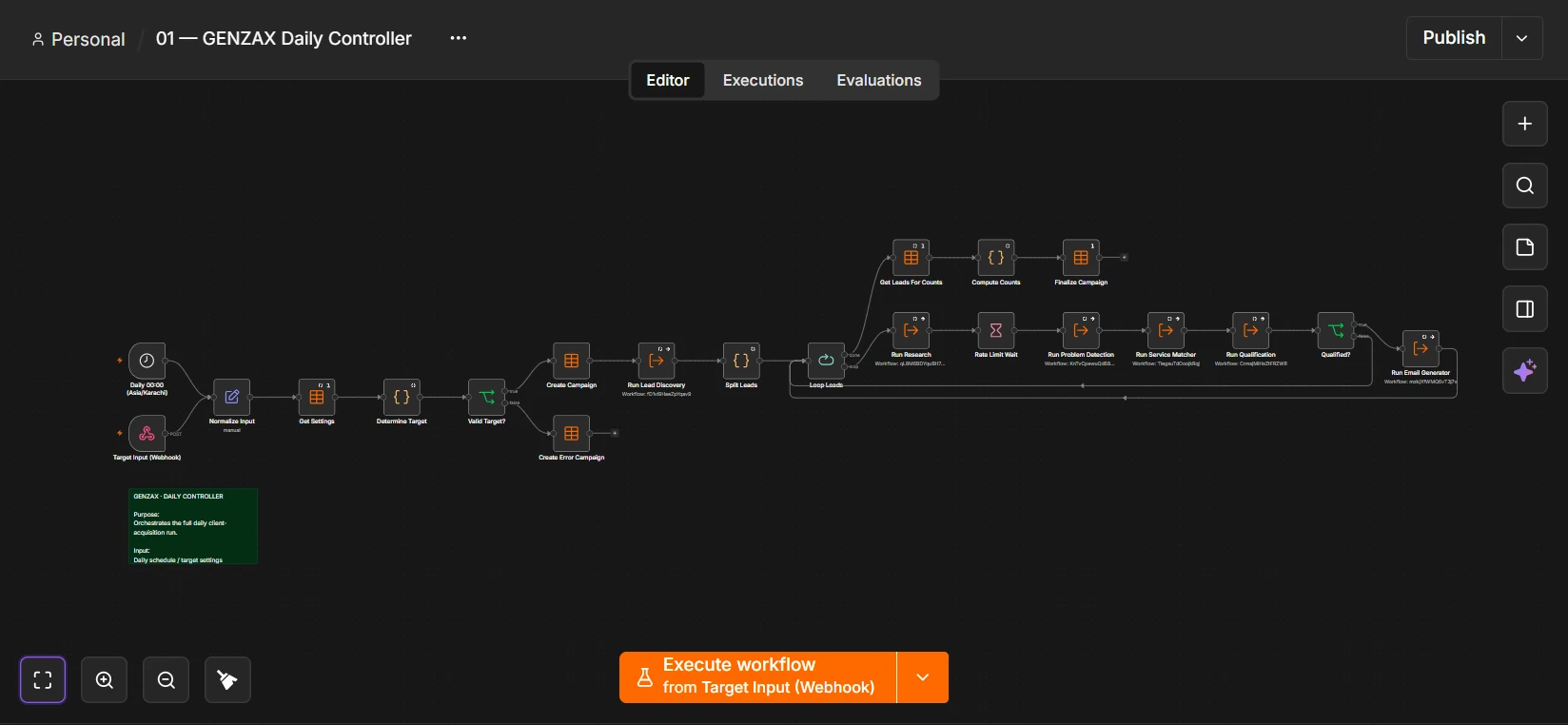
GENZAX AI Client Acquisition System
Self-initiated build — designed and built in-house; not commissioned by a client. Not connected to live mail credentials, so it is not running in production.
- Problem
- Client acquisition is a chain of separate jobs — finding businesses, reading their sites, deciding whether there is anything worth saying, then writing something specific enough to be worth reading. Done by hand the last job gets the least attention, which is exactly why most outreach reads as generic.
- Approach
- Split the whole pipeline into eleven independent workflows, one per stage, so each can be built, run and fixed on its own — and put a human approval step between a generated draft and anything actually being sent.
- Solution
- Built in n8n. A daily controller discovers businesses, researches each one, detects a real problem from that evidence, matches it to a GENZAX service, scores the lead in code against a threshold, and drafts personalized outreach. Separate workflows handle approval and sending, reply detection, timed follow-ups and an end-of-day report.
WHAT IT DEMONSTRATES
- Multi-workflow orchestration with sub-workflow calls, loops and rate limiting
- Structured AI output parsed into fields later stages can act on
- Human-in-the-loop approval and simulate-by-default send paths
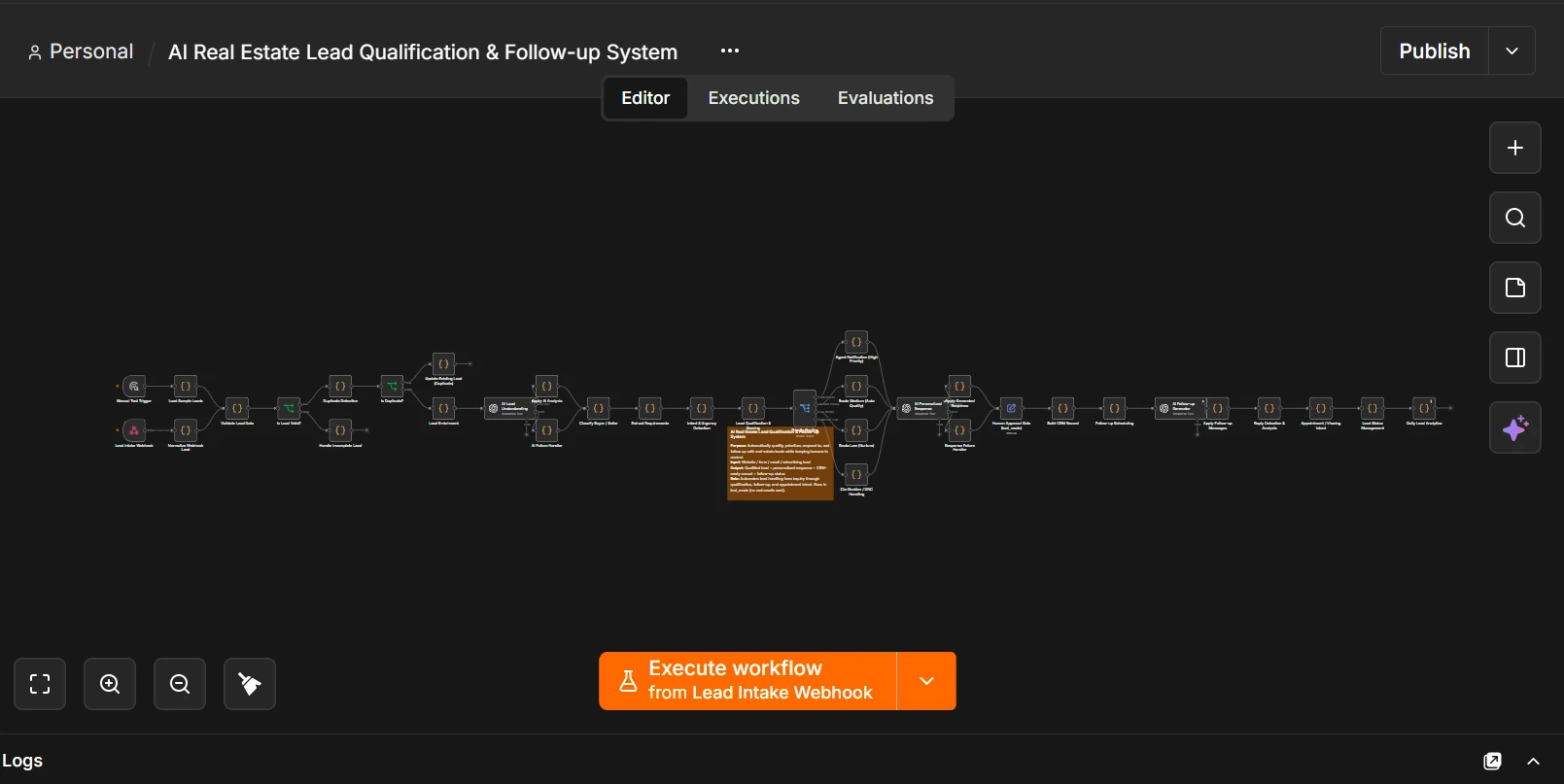
AI Real Estate Lead Qualification & Follow-up System
Self-initiated build — designed and built in-house; not commissioned by a client. Runs in demo mode against fictional sample leads, with no CRM, mail or calendar credentials connected.
- Problem
- Receiving property leads is not the hard part — what happens next is. One enquiry needs someone to read it, work out whether the person is buying or selling, pull out budget, location and timeline, judge how serious they are, check for a duplicate, write a real reply, update the record, and remember both to follow up and to stop the moment the lead answers.
- Approach
- Treat the enquiry as unstructured input and the lead record as structured output, then automate everything between them — with the AI instructed to use only what the message contains, and a human approval step before anything is sent.
- Solution
- Built in n8n. A webhook normalises the lead, validation and duplicate detection filter it, an AI step returns structured fields, and a 0–100 score across seven factors drives priority routing — with a clarification path for incomplete leads. From there it drafts a reply for approval, builds a CRM-ready record, notifies the agent, runs a bounded two-step follow-up, and stops on reply, conversion or a do-not-contact request.
WHAT IT DEMONSTRATES
- Unstructured text turned into structured, branchable fields
- Multi-factor lead scoring driving real routing decisions
- Bounded follow-up with explicit stop conditions and reply detection
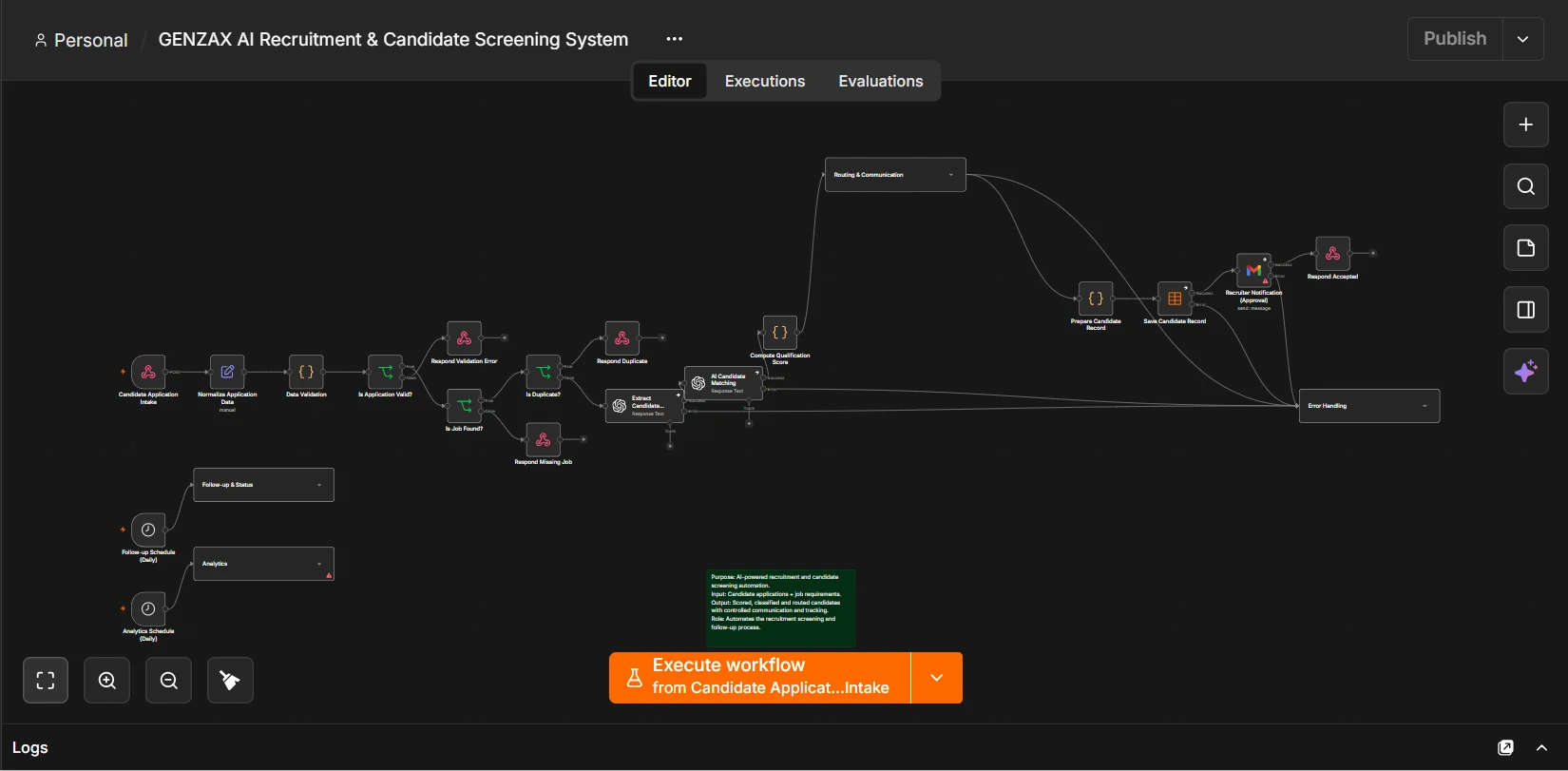
GENZAX AI Recruitment & Candidate Screening System
GENZAX portfolio project — designed and built in-house; not commissioned by a client. No ATS, mailbox or calendar credentials are connected, so no candidate has been processed or contacted by it.
- Problem
- One open role can draw hundreds of applications, and almost all of the work sits after they arrive. Someone has to read each CV, hold the job requirements in their head, judge the match, spot the repeat applicant, write back, flag the good ones, and remember to follow up — and under time pressure the same candidate gets judged differently on a Monday than on a Friday.
- Approach
- Automate the reading and the comparison; leave the judgement with the recruiter. The AI is instructed never to fabricate candidate information, anything missing is recorded as unknown rather than inferred, and no candidate-facing message goes out without a person approving it.
- Solution
- Built in n8n as twenty connected modules. An application is validated, deduplicated and parsed; the CV and the job description are analysed separately then compared field by field; and a transparent 0–100 score across eight weighted factors drives classification and priority routing. From there it drafts candidate communication for approval, writes a structured candidate record, notifies the recruiter, detects interview intent, and runs a maximum of two follow-ups with explicit stop conditions.
WHAT IT DEMONSTRATES
- CV and job spec analysed independently, then compared field by field
- Transparent 0–100 scoring across eight weighted, adjustable factors
- Human approval on every candidate-facing message, and bounded follow-up
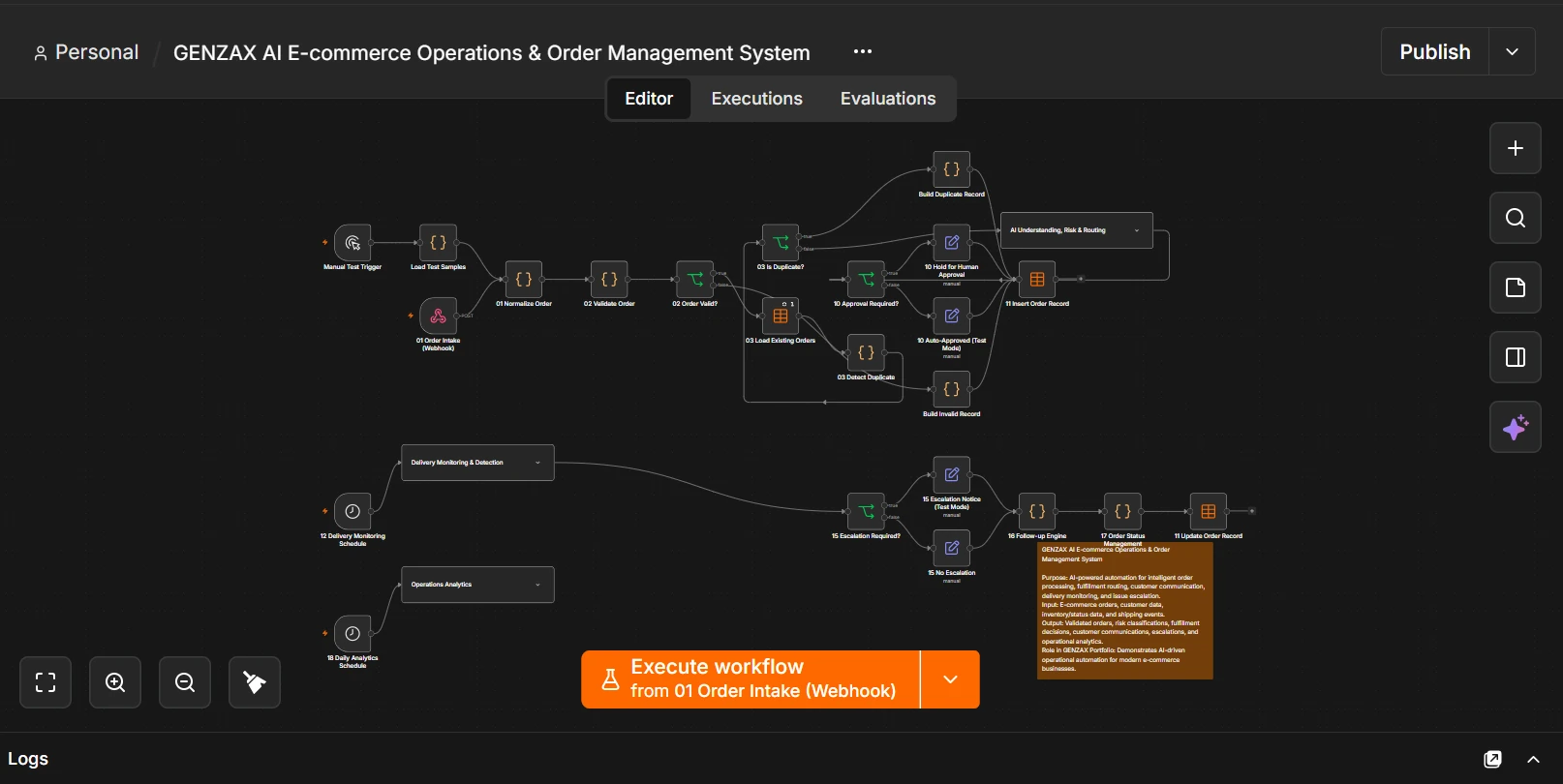
GENZAX AI E-commerce Operations & Order Management System
GENZAX portfolio project — designed and built in-house; not commissioned by a client. Runs on sample order data with no store, payment, carrier or mailbox credentials connected.
- Problem
- Selling online is the easy half. The operational half is a long tail of small jobs — checking an order is valid, spotting the customer who double-submitted, deciding whether an order looks risky, working out where to fulfil it from, and then noticing days later that a parcel has stopped moving. Most of it only happens when someone remembers, and the failures stay invisible until a customer complains.
- Approach
- Split the order lifecycle in two and automate both halves: the intake path that turns an arriving order into a validated, classified, routed record, and a scheduled post-dispatch path that asks a different question — has anything gone wrong since. Orders outside normal parameters stop for a person rather than being auto-processed.
- Solution
- Built in n8n. An intake webhook normalises and validates the order, duplicates are detected against existing orders, and an AI understanding, risk and routing stage classifies the order and decides fulfilment. An approval gate holds exceptions for a person. Two separate schedules then run delivery monitoring with delay and issue detection into a conditional escalation branch, plus a follow-up engine, order status management and daily operations analytics.
WHAT IT DEMONSTRATES
- An event-driven intake path plus two independent scheduled monitoring paths
- Invalid and duplicate orders recorded as outcomes rather than silently dropped
- Risk classification driving a real approval gate, with test-mode paths marked in the workflow
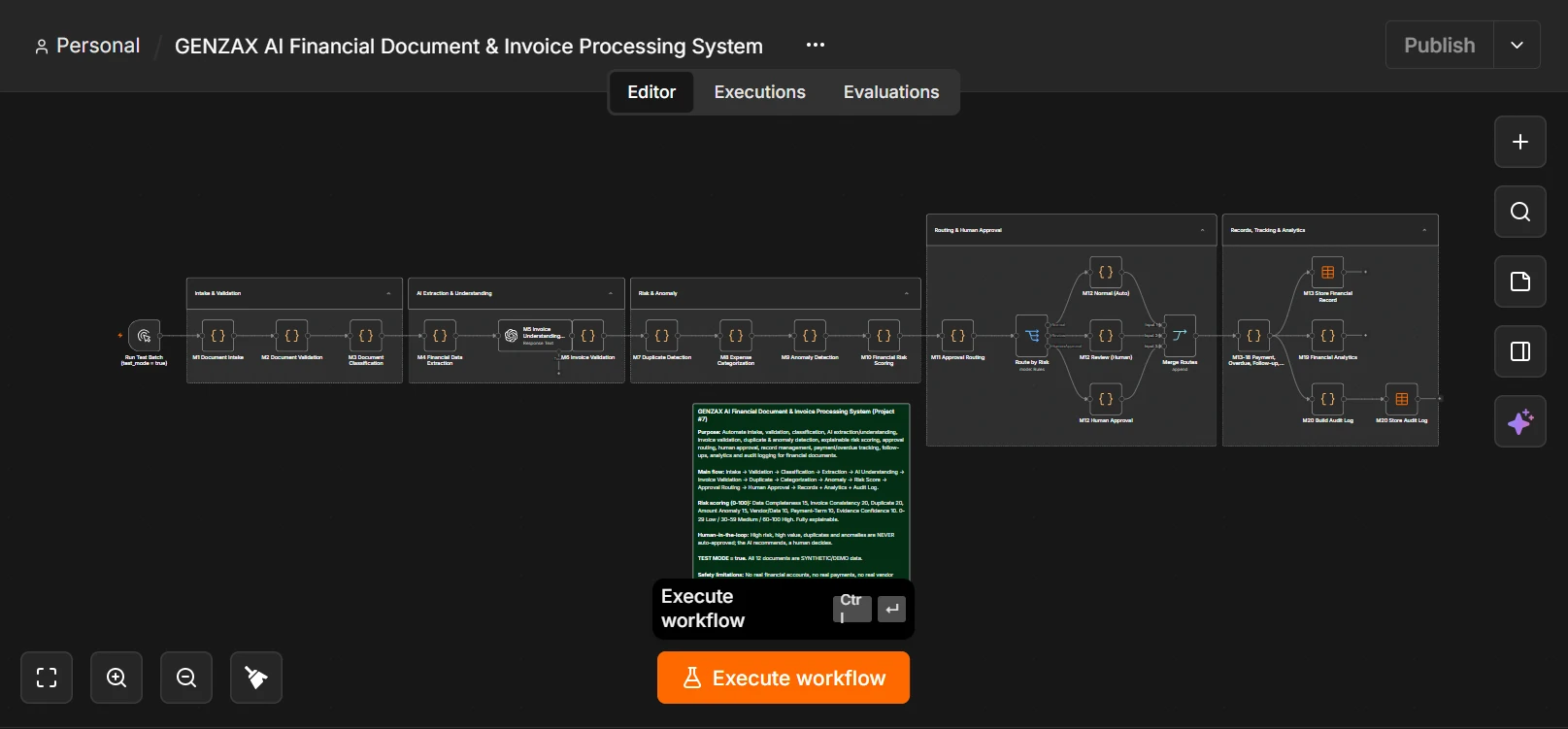
GENZAX AI Financial Document & Invoice Processing System
GENZAX portfolio project — designed, built and tested in-house; not commissioned by a client. Runs in test mode on twelve synthetic documents, with no financial account, payment system or vendor data connected.
- Problem
- Accounts payable is where a business quietly loses money to its own process. Documents arrive in every format, and someone has to read the numbers off each one, check the line items add up, notice this is the same invoice that came in three weeks ago under a different reference, spot the amount well outside what this vendor normally bills, and track when it is due. The two failures that cost most — paying a duplicate and paying something nobody checked — are the ones a tired person makes.
- Approach
- Automate the reading and the checking; route the judgement to a person by risk rather than by volume. Every document is scored on an explainable 0–100 scale with each factor recorded, and one rule is absolute: high-risk, high-value, duplicate and anomalous documents are never auto-approved. The AI recommends, a human decides, and both are written to an audit log.
- Solution
- Built in n8n as twenty modules across five stages. Intake, validation and classification; AI extraction, invoice understanding and self-consistency validation; duplicate detection, expense categorization, anomaly detection and risk scoring. A rules-based switch then routes by risk into an automatic path and a human review path that merge back into one stream, before financial records, payment and overdue tracking, follow-ups, analytics and a stored audit log.
WHAT IT DEMONSTRATES
- Explainable 0–100 risk scoring across seven weighted, recorded factors
- Risk-based routing with automatic and human branches that merge back
- Hard non-auto-approval rules, and an audit log stored for every document
// MORE WORK
Recent projects.
The systems above were built to prove the patterns work. If you've got a process that looks like any of them, the next one could be yours.