 ENZAX
ENZAXGENZAX AI Recruitment & Candidate Screening System
GENZAX portfolio project — designed and built in-house; not commissioned by a client and not run against real applicants. No ATS, mailbox or calendar credentials are connected, so no candidate has been processed or contacted by it.
An AI-assisted recruitment automation that processes candidate applications, analyses experience against the job requirements, scores fit, routes strong candidates to a recruiter, drafts candidate communication and runs bounded follow-ups — with every candidate-facing message held behind human approval.
PROBLEM
A single open role can draw hundreds of applications, and almost all of the work sits after they arrive. Someone has to open each one, pull the relevant experience out of a CV written in whatever format the candidate chose, hold the job requirements in their head, judge how well the two match, spot the duplicate who applied to three roles, write back, tell the hiring manager about the good ones, and remember to follow up. Done by hand under time pressure, the same candidate can be judged differently on a Monday than on a Friday, and the applications at the bottom of the pile get the least attention regardless of who is in them.
APPROACH
Automate the reading and the comparison; leave the judgement with the recruiter. The workflow extracts what an application actually contains, compares it against the requirements in the job description, and produces a transparent score with the factors that made it up — so a recruiter can see why a candidate ranked where they did rather than being handed a verdict. Two constraints shape the build: the AI is instructed never to fabricate candidate information, and anything missing from an application is recorded as unknown rather than inferred. No candidate-facing message is sent without a person approving it.
SOLUTION
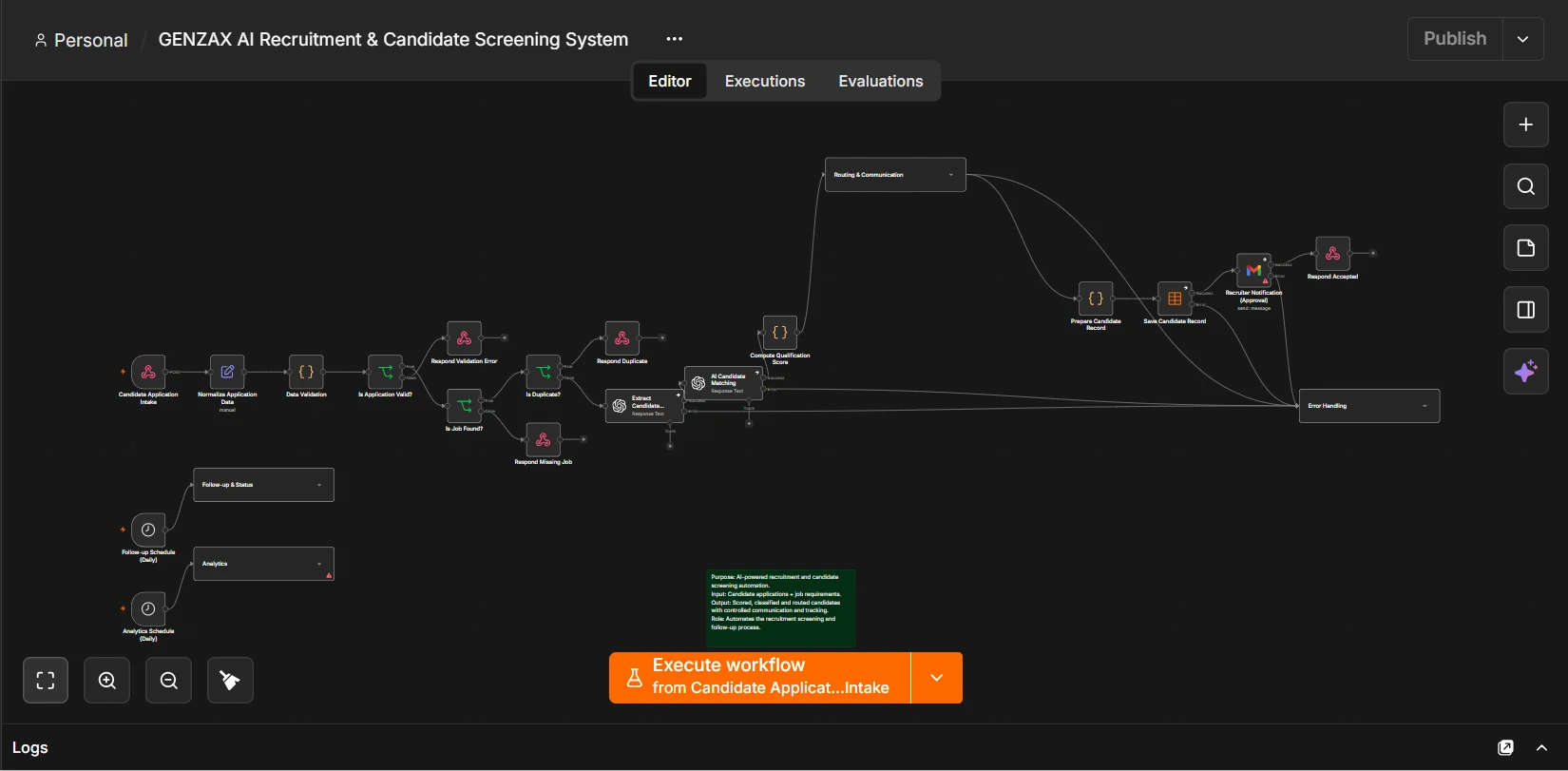
Built in n8n as a connected pipeline of twenty modules. An application is validated, checked against existing candidates for duplicates, and parsed into structured fields. The CV and stated experience are analysed, the job description is analysed separately into its own requirement set, and the two are matched — skills and experience compared explicitly rather than judged as a whole. A 0–100 qualification score across eight weighted factors drives classification into strong, potential or low match, and priority routing sends strong matches straight to a recruiter with a summary. From there the system drafts a personalized candidate response for approval, writes a structured candidate record, detects interview intent, runs a maximum of two follow-ups with explicit stop conditions, tracks status through the pipeline, and produces a daily recruitment summary.
WHAT IT DEMONSTRATES
- Two-sided analysis — the candidate and the job spec parsed separately, then compared, rather than one prompt asked for a verdict
- Transparent weighted scoring, where the factors behind a score stay visible to the recruiter
- Missing information handled as unknown, never inferred or filled in by the model
- Human approval standing between a drafted message and any candidate contact
- Bounded follow-up with explicit stop conditions, including a candidate opt-out
- Duplicate detection across multiple applications from the same person
WHERE THIS STANDS
This is a working automation prototype built by GENZAX as a portfolio project. It has not been used on a real hiring process: no ATS, job board, mailbox or calendar is connected, and no real applications have passed through it. There are therefore no candidates processed, no accuracy figures, no hiring outcomes, no time or cost savings and no client results to report — and none are claimed anywhere on this page. The qualification score is an AI-assisted ranking mechanism to help a recruiter prioritise reading order. It is not a measure of a person's suitability for a job, and it is not a hiring decision.
// PIPELINE
One application, eighteen stages.
Each stage adds to the record the previous one produced, so an application that arrives as a CV and a covering note ends as a structured, scored candidate a recruiter can act on.
// SYSTEM MODULES
Twenty modules, in the order they run.
Each module owns one job and writes its result back to the candidate record, so any stage can be inspected or changed without unpicking the rest.
Application intake
An application arrives from a form, job board feed or manual entry and is converted into one standard candidate structure regardless of source.
Data validation
Essential fields are checked for presence and format. An incomplete application is flagged as incomplete rather than passed silently down the pipeline.
Duplicate detection
The candidate is checked against existing records so somebody applying to a second role is recognised rather than processed as a new person.
Information extraction
Contact details, role applied for, stated experience and availability pulled into structured fields. Anything absent is recorded as unknown.
Resume analysis
The CV is read for skills, roles held, years of relevant experience, education and certifications — using only what the document actually states.
Job requirement analysis
The job description is parsed separately into required skills, preferred skills, experience level, education and location expectations.
AI candidate matching
The two structured sets are compared against each other, so the match is a comparison of stated facts rather than one impression of a whole application.
Skills & experience comparison
Required skills matched, missing skills listed, and relevant experience weighed against the level the role asks for — each recorded, not just summarised.
Qualification scoring
A 0–100 score built from eight weighted factors, with the contribution of each kept on the record so the number can be explained.
Classification
Strong match, potential match, or low match and review — a band for prioritising reading order, not a decision about the person.
Priority routing
Strong matches go straight to a recruiter, potential matches continue through the pipeline, and incomplete or ambiguous applications take a review path.
Response generator
A personalized reply drafted from that candidate's actual application — no invented role details, salary figures, timelines or interview commitments.
Human approval
Approve, edit or skip. Every candidate-facing message stops here first — the system does not send on its own.
Candidate record
Contact details, role, skills, experience, education, score, classification, status, follow-up state and interview state held as one structured record.
Recruiter notification
A strong match is summarised for the recruiter — who they are, matched skills, gaps, experience, score and recommended next action.
Interview intent
A candidate asking about or agreeing to an interview is recognised and turned into a structured request. It is never reported as booked unless a real calendar confirms it.
Follow-up engine
A maximum of two follow-ups, stopping early on a reply, a decline, a hire, a rejection, an opt-out, or a manual stop by the recruiter.
Status management
New, screening, shortlisted, contacted, follow-up, replied, interview requested, interview scheduled, then hired, rejected or closed.
Shortlist & rejection comms
Both outcomes get a drafted, reviewable message, so the candidates who are not moving forward still hear back instead of being left waiting.
Recruitment analytics
A daily summary of applications received, screened, shortlisted, contacted, replied, interviewing and rejected, per role.
// QUALIFICATION SCORING
Where the score comes from.
Eight weighted factors summing to 100. The weights are visible on purpose: a recruiter should be able to see why a candidate ranked where they did, and change the weighting when the role calls for it.
- 25 points
- Required skills match — how much of what the role asks for is actually evidenced in the application
- 20 points
- Relevant experience — experience that relates to this role, not total years worked
- 15 points
- Role and job fit — how closely previous roles line up with the one being filled
- 10 points
- Experience level against the seniority the role is written for
- 10 points
- Education and certification fit, where the role actually requires it
- 5 points
- Location and availability fit
- 10 points
- Application quality — completeness and clarity of what was submitted
- 5 points
- Evidence confidence — how much of the above is stated rather than inferred
80–100 · Strong match
Routed to a recruiter immediately, with the matched skills and the gaps both summarised.
60–79 · Potential match
Continues through the pipeline for review and communication rather than being filtered out.
0–59 · Low match / review
Held for review. A low score often means thin evidence rather than a weak candidate, which is why it is a review band and not a rejection.
// AI DECISION MAKING
What the AI is and is not allowed to do.
Screening decisions affect people's work, so the constraints are part of the build rather than a disclaimer added afterwards.
No fabricated information
The model is instructed to use only what the application and CV contain. It does not infer a skill from a job title or estimate years of experience.
Missing means unknown
An absent detail is recorded as unknown and lowers evidence confidence, rather than being guessed at and scored as if it were present.
Evidence-based only
Every element of a score traces back to something stated in the application, so a recruiter can check the reasoning against the source.
Human approval on contact
Approve, edit or skip on every candidate-facing message. Nothing reaches a candidate without a person releasing it.
Assists, does not decide
The system ranks and prepares. Shortlisting, rejecting and hiring stay with the recruiter — the score is a reading order, not a verdict.
Bounded follow-up
Two follow-ups at most, stopping on a reply, decline, hire, rejection, opt-out or manual stop. A candidate cannot be chased indefinitely.
// BUILT TO DEMONSTRATE
System capabilities.
What the build actually does. There are no client results here because there is no client — this is a GENZAX portfolio project, and the capabilities below are the deliverable.
CAPABILITIES
- Applications from multiple sources normalised into one candidate structure
- Validation and duplicate detection before any processing cost is spent
- CV and job description analysed independently, then compared field by field
- Transparent 0–100 scoring across eight weighted, adjustable factors
- Classification into strong, potential and review bands driving real routing
- Drafted candidate communication for both shortlist and rejection outcomes
- Human approval gate on every outbound candidate message
- Structured candidate record covering skills, experience, score, status and history
- Recruiter notification summarising matches and gaps for strong candidates
- Interview intent detection and bounded, stop-aware follow-up
- Daily recruitment summary per role
// TECHNOLOGY
What it is built on.
Only what the build actually uses. ATS, job board and calendar integrations are what the architecture is shaped for, not what it currently has.
- Platform
- n8n. Every trigger, branch, transformation and routing decision in the pipeline is an n8n node.
- AI processing
- LLM-based structured analysis for information extraction, resume analysis, job requirement analysis, candidate matching and response drafting.
- Data processing
- Structured candidate data throughout — validation, deduplication, comparison and scoring handled deterministically rather than by the model.
- Logic
- Conditional routing and classification rules driving the priority branches, the review path and every follow-up stop condition.
- Storage
- Structured candidate records in n8n-compatible storage, shaped so a real ATS or database can be connected later.
- Human approval
- An approve / edit / skip step in the workflow itself, on the path between a drafted message and any candidate contact.
- Mode
- Demo and test mode. No external credentials are connected; the architecture is designed for them to be added.