 ENZAX
ENZAXAI Real Estate Lead Qualification & Follow-up System
Self-initiated build — designed and built in-house; not commissioned by a client. It runs in demo mode against fictional sample leads, with no CRM, mail, calendar or lead-source credentials connected, so nothing here has processed a real enquiry.
An n8n workflow that takes an incoming property enquiry and turns it into a structured, qualified, prioritized lead — captured, validated, deduplicated, understood, scored, routed, answered and followed up, with the agent still holding the decisions that matter.
PROBLEM
Receiving property leads is not the hard part. What happens next is. A single enquiry can need an agent to read it, work out whether the person is buying, selling, renting or investing, pull out the property requirements, budget, location and timeline, judge how serious they are, check whether they already exist in the system, write a reply that actually answers them, update the record, tell the right agent, and then remember to follow up — and stop following up the moment the lead replies. Done by hand, across every channel a business advertises on, the qualification comes out inconsistent and the follow-ups are the first thing to get dropped.
APPROACH
Treat the enquiry as unstructured input and the lead record as structured output, then automate everything in between. The workflow reads the message, extracts only what the message actually contains, scores it against business-relevant factors rather than a vague impression, and routes it by priority. Two rules shape the rest: the AI is instructed to use only information present in the lead and never to invent a missing detail, and no external communication leaves the system without a person approving it. A lead with too little information gets a clarification path rather than a confident wrong answer.
SOLUTION
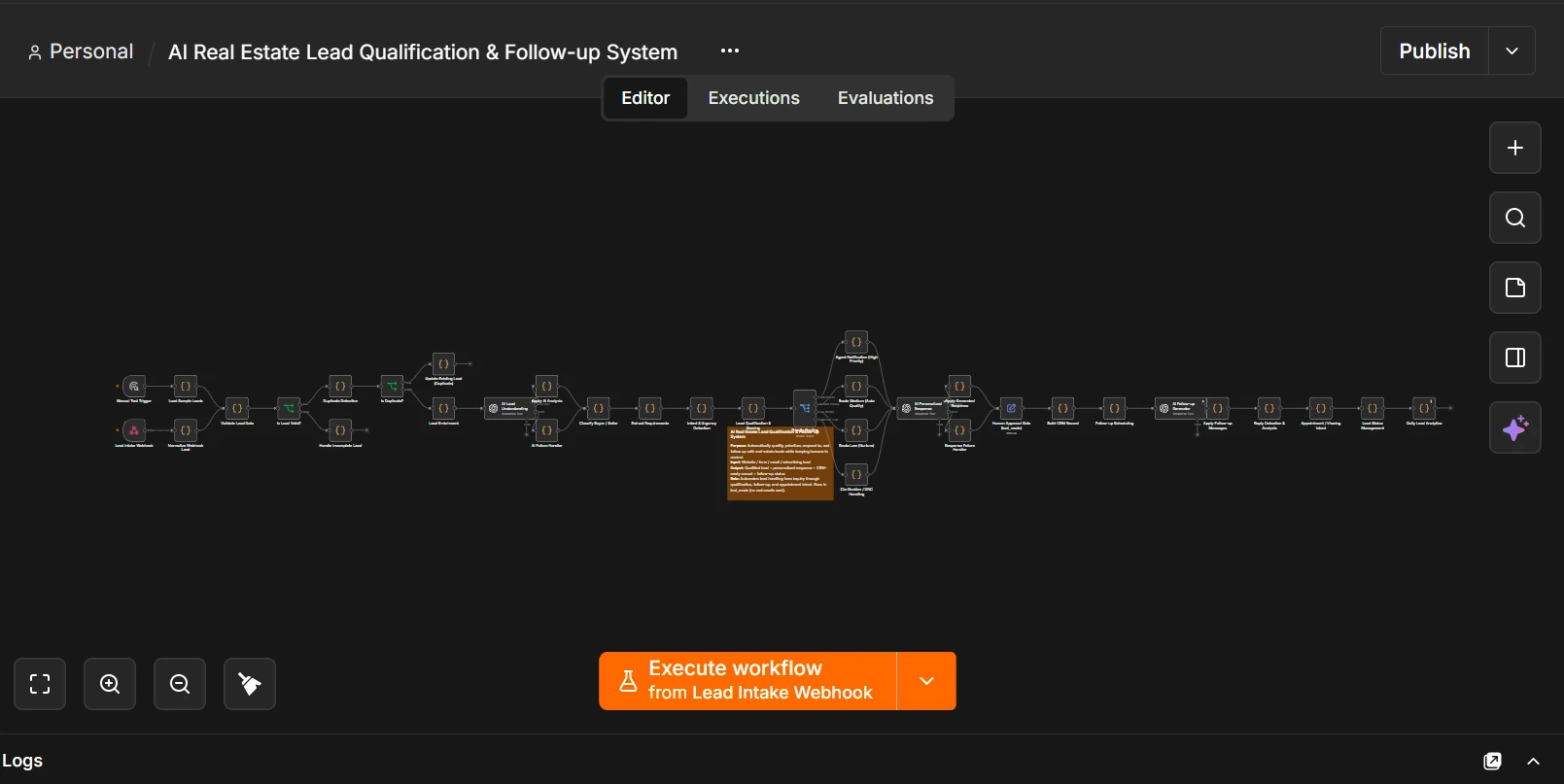
Built in n8n as a single connected pipeline. A webhook (or manual entry) normalises the incoming lead, validation checks the essential fields, and duplicate detection stops a record that already exists from re-entering the pipeline. An AI step reads the enquiry and returns structured fields — lead type, property type, location, budget, timeline, intent, urgency, requirements, open questions, missing information and likely objections. A scoring step turns that into a 0–100 qualification score, which drives priority routing: high, medium, low, or a clarification path for incomplete leads. From there the workflow drafts a personalized reply for human approval, builds a CRM-ready record, prepares an agent notification for high-priority leads, schedules a bounded two-step follow-up, watches for a reply, detects appointment intent, and tracks the lead through a defined set of lifecycle states.
WHAT IT DEMONSTRATES
- Unstructured text turned into structured, branchable fields — the whole pipeline downstream depends on it
- Multi-factor lead scoring driving real routing decisions rather than a label nobody acts on
- Human-in-the-loop approval sitting between a generated reply and any outbound message
- Bounded follow-up with explicit stop conditions, including reply and do-not-contact detection
- An explicit path for incomplete and ambiguous leads instead of forcing every record into a category
- Error handling for missing data, invalid AI output, duplicates and processing failures
WHERE THIS STANDS
This is a working automation prototype, built and exercised against fictional sample leads covering a range of scenarios. It is not connected to a CRM, a mailbox, a calendar or any live lead source — those integrations are what the architecture is shaped for, not what it currently has. Nothing here has handled a real enquiry, so there are no clients, leads, response times, conversion rates or time savings to report, and none are claimed anywhere on this page.
// PIPELINE
One enquiry, sixteen stages.
Each stage takes the record the previous one produced and adds to it, so what starts as a paragraph of free text ends as a lead an agent can act on without reading the original message first.
// HOW IT WORKS
What each stage actually does.
Fifteen steps between a raw message arriving and a lead an agent can act on. Every one of them is a job somebody would otherwise be doing by hand, for every enquiry.
Lead intake
A lead arrives from a website form, landing page, email, ad source, social lead form or manual entry, and is converted into one standard lead structure regardless of where it came from.
Data validation
Essential fields are checked for presence and format — email and contact details in particular. An incomplete lead is flagged as incomplete rather than passed silently down the pipeline.
Duplicate detection
The lead is checked against existing records by email, phone and lead ID, so somebody who enquired last week does not re-enter the pipeline as a new prospect.
AI lead understanding
The enquiry is read and returned as structured fields: buyer, seller, investor, rental or unknown, plus property type, location, budget, timeline, intent, urgency, requirements, open questions, missing information and likely objections.
Requirement extraction
Free text becomes fields. The model is instructed to use only what the message contains — an absent budget is recorded as missing, not estimated.
Lead qualification
A 0–100 score built from intent strength, requirement clarity, budget readiness, timeline, location and property fit, contact quality and engagement quality — seven factors rather than one impression.
Priority routing
High priority goes for immediate agent attention, medium continues through qualification and follow-up, low enters nurture, and incomplete or unknown leads take a clarification path instead of being wrongly categorised.
Personalized response
A reply drafted from that lead's own enquiry, referencing their real requirements and asking the questions that are genuinely missing — without inventing availability, quoting prices, or claiming an appointment exists.
Human approval
Approve, edit or skip. Nothing goes out on its own — the workflow is built for controlled automation rather than unattended outbound messaging.
CRM-ready record
Contact details, source, classification, requirements, budget, timeline, intent, urgency, score, status, follow-up state and meeting state written as one structured record, shaped so a real CRM can be connected to it.
Agent notification
High-priority leads are summarised for the agent: who they are, what they want, budget, location, timeline, score, intent and the recommended next action — enough to act without reading the original message.
Automated follow-up
Two follow-ups, then it stops. It also stops early on a reply, a do-not-contact request, a conversion, a manual stop or a closed lead — the bound is part of the design, not a setting to remember.
Reply detection
An inbound reply is classified as interest, a question, an objection, an appointment request, not interested, or a do-not-contact request — and further automated follow-up stops there.
Appointment intent
A request for a viewing, consultation, call or meeting becomes a structured appointment request ready for a calendar system. It is never reported as confirmed unless a real booking system confirms it.
Status tracking
New, processing, qualified, contacted, follow-up, replied, appointment requested, appointment confirmed, then converted, nurture or closed — one consistent view of where every lead stands.
// EXTRACTION
What the AI step actually produces.
The whole pipeline turns on this one conversion. Everything after it — scoring, routing, the drafted reply, the CRM record — reads fields, not prose.
“I am looking for a 3-bedroom house in Dallas around $400k. I would like to move within the next two months.”
- Lead type
- Buyer
- Property
- House, 3 bedrooms
- Location
- Dallas
- Budget
- ~$400,000
- Timeline
- Within 2 months
- Intent
- High
// ARCHITECTURE
Five layers, in order.
Grouping the stages by what they are for makes the shape of the system clearer than listing sixteen nodes: everything before the decision layer is preparation, everything after it is action.
- Input
- Website forms · landing pages · email · advertising leads · social lead forms · manual entry
- Processing
- Validation · normalization · duplicate detection · AI understanding · requirement extraction · intent detection · lead scoring
- Decision
- Qualification · priority routing · missing-information detection · human approval
- Action
- Personalized response · CRM update · agent notification · follow-up scheduling · appointment request
- Tracking
- Reply detection · lead status · follow-up status · appointment status · daily analytics
// KEY CAPABILITIES
What the build actually gives you.
AI lead understanding
Unstructured property enquiries converted into structured lead information, using only what the message contains.
Multi-factor qualification
A 0–100 score built from seven business-relevant factors, so qualification is consistent across leads and across days.
Duplicate protection
Email, phone and lead ID checked before processing, so an existing contact is not treated as a new prospect.
Personalized communication
Replies written from the actual enquiry, with no invented availability, prices, bookings or promises.
Human-in-the-loop
Approve, edit or skip before anything is sent. Important communication stays under a person's control.
Bounded follow-up
Two attempts with explicit stop conditions — structured persistence rather than endless messaging.
Reply detection
An inbound reply is classified and automated follow-up stops, including on do-not-contact requests.
Appointment intent
Viewing, consultation, call and meeting requests recognised and turned into a structured appointment request.
CRM-ready architecture
A lead record shaped so a real CRM, mailbox and calendar can be connected without reshaping the pipeline.
Error handling
Incomplete data, invalid AI output, duplicates and processing failures each have a defined path rather than a silent failure.
// DEMO SCENARIOS
How it was exercised.
The workflow was run against fictional sample leads chosen to hit the branches that matter — particularly the ones where the right behaviour is to stop, ask, or refuse to categorise. These are test inputs, not customers, and the outcomes are not presented as business results.
SAMPLE LEADS COVERED
- High-intent buyer with complete requirements
- Buyer with missing information — budget or timeline absent
- Seller enquiry rather than a purchase
- Low-intent general information request
- Duplicate of an existing lead
- Appointment request
- Lead ambiguous enough to need human clarification
- Do-not-contact request
// TECHNOLOGY
What it is built on.
Only what the build actually uses. The integrations it is shaped for — CRM, mailbox, calendar, live lead sources — are not connected in this version.
- Platform
- n8n. Every trigger, branch, transformation and routing decision in the pipeline is an n8n node.
- Input
- A lead intake webhook for automated sources, plus a manual trigger and sample-lead path for testing.
- AI processing
- LLM-based structured analysis for lead understanding, requirement extraction, response drafting and reply classification, with a failure path for output that does not parse.
- Data processing
- JavaScript transformation nodes for normalization, validation, deduplication and scoring — deterministic work kept out of the model.
- Logic
- Conditional routing and qualification rules driving the priority branches, the clarification path and every follow-up stop condition.
- Storage
- CRM-ready structured lead records held in n8n-compatible storage, shaped for a real CRM to be connected later.
- Mode
- Demo and test mode. No external credentials are connected; the architecture is designed for them to be added.