 ENZAX
ENZAXGENZAX AI E-commerce Operations & Order Management System
GENZAX portfolio project — designed and built in-house; not commissioned by a client. It runs on sample order data with no store, payment, carrier or mailbox credentials connected, so no real order, customer or payment has ever passed through it.
An operations automation that takes an incoming e-commerce order and carries it through validation, duplicate detection, AI understanding, risk classification, fulfilment routing and customer communication — then keeps watching it, spotting delays and issues after dispatch and escalating the ones that need a person.
PROBLEM
Selling online is the easy half. The operational half is a long tail of small jobs that all have to happen and none of which are interesting: checking an order is actually complete and valid, spotting the customer who double-submitted at checkout, deciding whether an order looks risky enough to hold, working out where it should be fulfilled from, telling the customer something useful, and then — the part that quietly costs the most — noticing days later that a parcel has stopped moving. Most of that work only gets done when someone remembers, and the failures are invisible until a customer complains.
APPROACH
Split the order lifecycle into two halves and automate both. The first is the intake path: everything from an order arriving to a validated, classified, routed record. The second is the post-dispatch path, which runs on its own schedule and asks a different question — has anything gone wrong since. Two rules shape the build: orders that fall outside normal parameters stop for a person rather than being auto-processed, and the system never invents order, customer, inventory or shipping information it does not have.
SOLUTION
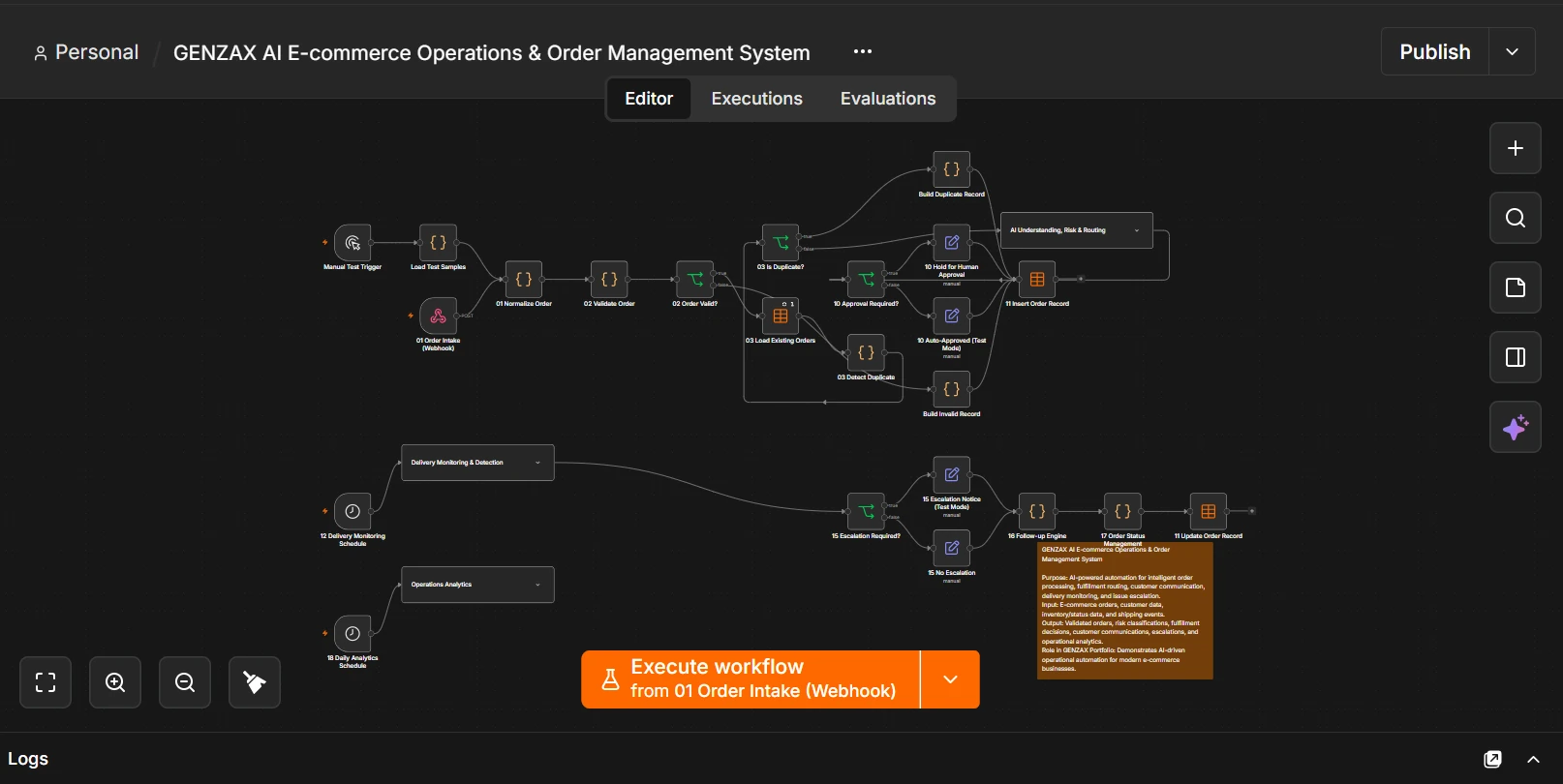
Built in n8n. An order intake webhook (or a manual trigger with sample orders for testing) normalises the order and validates it; anything invalid is written as an invalid record rather than dropped. Existing orders are loaded and checked for duplicates, and a duplicate is recorded as such instead of being processed twice. Valid, unique orders pass into an AI understanding, risk and routing stage that reads the order and customer context, classifies risk, and decides fulfilment routing. An approval gate then splits the flow: orders needing review are held for human approval, the rest are auto-approved — which in this build is explicitly a test-mode path — and an order record is written either way. Two separate schedules run the second half: delivery monitoring detects delays and issues and decides whether escalation is required, and a daily analytics schedule summarises operations. A follow-up engine and order status management close the loop, updating the same order record.
WHAT IT DEMONSTRATES
- A lifecycle split into an event-driven intake path and two scheduled monitoring paths, rather than one linear run
- Invalid and duplicate orders recorded as outcomes instead of being silently discarded
- Risk classification driving a real approval gate, not just a label on a record
- Human approval holding the orders that fall outside normal parameters
- Post-dispatch monitoring — delay and issue detection with a conditional escalation branch
- Test-mode paths marked as such in the workflow itself, so a demo run can never be mistaken for a live one
WHERE THIS STANDS
This is a working automation prototype built by GENZAX as a portfolio project, running on sample order data. No store platform, payment provider, carrier, inventory system or mailbox is connected, and the auto-approval and escalation notice steps are explicitly test-mode paths in the workflow. No real order, customer record or payment has passed through it. There are therefore no clients, no order volumes, no revenue, no delivery statistics, no ROI and no business results to report — and none are claimed anywhere on this page.
// ORDER LIFECYCLE
Intake, then everything after it.
The first eleven stages run when an order arrives. The last seven run on their own schedules, because the questions that matter after dispatch are not the ones that mattered at checkout.
// KEY MODULES
What each stage actually does.
Each module owns one job and writes back to the same order record, which is what lets the scheduled monitoring paths pick an order up days after the intake path finished with it.
Order intake
An order arrives on a webhook, or from the manual trigger with sample orders during testing, and is normalised into one standard order structure regardless of source.
Order validation
Required fields, formats and internal consistency are checked. An order that fails is written as an invalid record with the reason attached, rather than dropped or half-processed.
Duplicate detection
Existing orders are loaded and compared against the incoming one, so the customer who double-submitted at checkout produces a duplicate record instead of two fulfilments.
Customer understanding
The order and the customer context around it are read into structured fields — what was ordered, by whom, and anything about the order that changes how it should be handled.
Risk detection
Signals that make an order unusual are identified and recorded against it, with the reasoning kept so an operator can see why an order was flagged rather than being handed a verdict.
Order classification
Each order is classified by risk and handling requirement, and that classification is what drives every routing decision after it.
Inventory check
Availability is checked against the inventory data the system holds, so an order that cannot be fulfilled as placed is identified before a promise is made to the customer.
Fulfilment routing
A fulfilment decision is made from the classification and availability, so the order leaves this stage with a route attached rather than waiting for someone to decide.
Customer communication
Customer-facing messages are drafted from that order's own details — no invented delivery dates, stock levels, refunds or commitments the business has not made.
Human approval
An approval gate splits the flow: orders needing review are held for a person, and the auto-approved path is explicitly marked as test mode in this build.
Order record
One structured record per order — contents, customer, classification, risk, fulfilment route, approval state and status — inserted on intake and updated by every later stage.
Delivery monitoring
A scheduled path that revisits orders after dispatch. This is the half of operations that normally depends on somebody remembering to check.
Delay detection
Orders that have stopped progressing as expected are identified from the shipping and status data held against them.
Issue detection
Problems beyond a simple delay are separated out, because a stuck parcel and a failed delivery need different responses.
Escalation
A conditional branch decides whether an order needs a person. Escalation produces a notice — a test-mode path in this build — and everything else takes the no-escalation route without noise.
Customer follow-up
A follow-up engine handles the orders that need the customer told something after the fact, driven by what monitoring actually found.
Order status management
Status is resolved and written back to the order record, so the order's current state is one field rather than something inferred from a chain of events.
Operations analytics
A daily schedule aggregates the operational picture — what came in, what was held, what was flagged, what is delayed and what was escalated.
// SAFETY CONTROLS
What the automation is not allowed to do.
Order operations touch money, stock and customers, so the limits are built into the workflow rather than written on top of it afterwards.
No fabricated order data
The system works from the order, customer, inventory and shipping data it actually holds. It does not infer stock, guess a delivery date or invent an order detail.
Approval gate on exceptions
Orders that fall outside normal parameters are held for a person. The gate is a branch in the workflow, not a setting somebody has to remember to switch on.
Test-mode paths marked
Auto-approval and escalation notices are labelled as test mode in the workflow itself, so a demo run cannot be mistaken for a live one.
Failures are recorded
Invalid and duplicate orders become records with a reason attached rather than disappearing, so nothing fails silently.
No promises to customers
Drafted messages do not commit to dates, refunds, replacements or stock the business has not actually confirmed.
Assists, does not decide
Risk classification and routing prepare the decision and show the reasoning. Holding, cancelling and refunding stay with the operator.
// BUILT TO DEMONSTRATE
System capabilities.
What the build actually does. There are no client results here because there is no client — this is a GENZAX portfolio project, and the capabilities below are the deliverable.
CAPABILITIES
- Webhook and manual-trigger intake normalised into one order structure
- Validation with invalid orders captured as records, not dropped
- Duplicate detection against existing orders before any fulfilment decision
- AI understanding of the order and customer context into structured fields
- Risk detection and order classification driving downstream routing
- Inventory checking and fulfilment routing as a single decision stage
- Drafted customer communication grounded in the order's own details
- Human approval gate for exceptions, with a marked test-mode auto path
- Structured order record inserted on intake and updated throughout the lifecycle
- Scheduled post-dispatch delivery monitoring with delay and issue detection
- Conditional escalation, customer follow-up and order status management
- Daily operations analytics across the whole order set
// TECHNOLOGY
What it is built on.
Only what the build actually uses. Store platform, payment, carrier and inventory integrations are what the architecture is shaped for, not what it currently has.
- Platform
- n8n. Every trigger, branch, transformation and schedule in the system is an n8n node.
- Triggers
- An order intake webhook for automated sources, a manual trigger with sample orders for testing, and two independent schedules for delivery monitoring and daily analytics.
- AI processing
- LLM-based structured analysis for order and customer understanding, risk detection, classification, routing and customer communication drafting.
- Data processing
- Code nodes for normalization, validation, duplicate detection and record building — deterministic work kept out of the model.
- Logic
- Conditional branching at every decision point: order validity, duplicate, approval required, and escalation required.
- Storage
- Structured order records in n8n-compatible storage, inserted on intake and updated by the monitoring paths.
- Human approval
- A hold-for-approval step in the workflow, on the branch taken by orders that need review.
- Mode
- Demo and test mode. No store, payment, carrier, inventory or mail credentials are connected; auto-approval and escalation notices are marked test-mode paths.